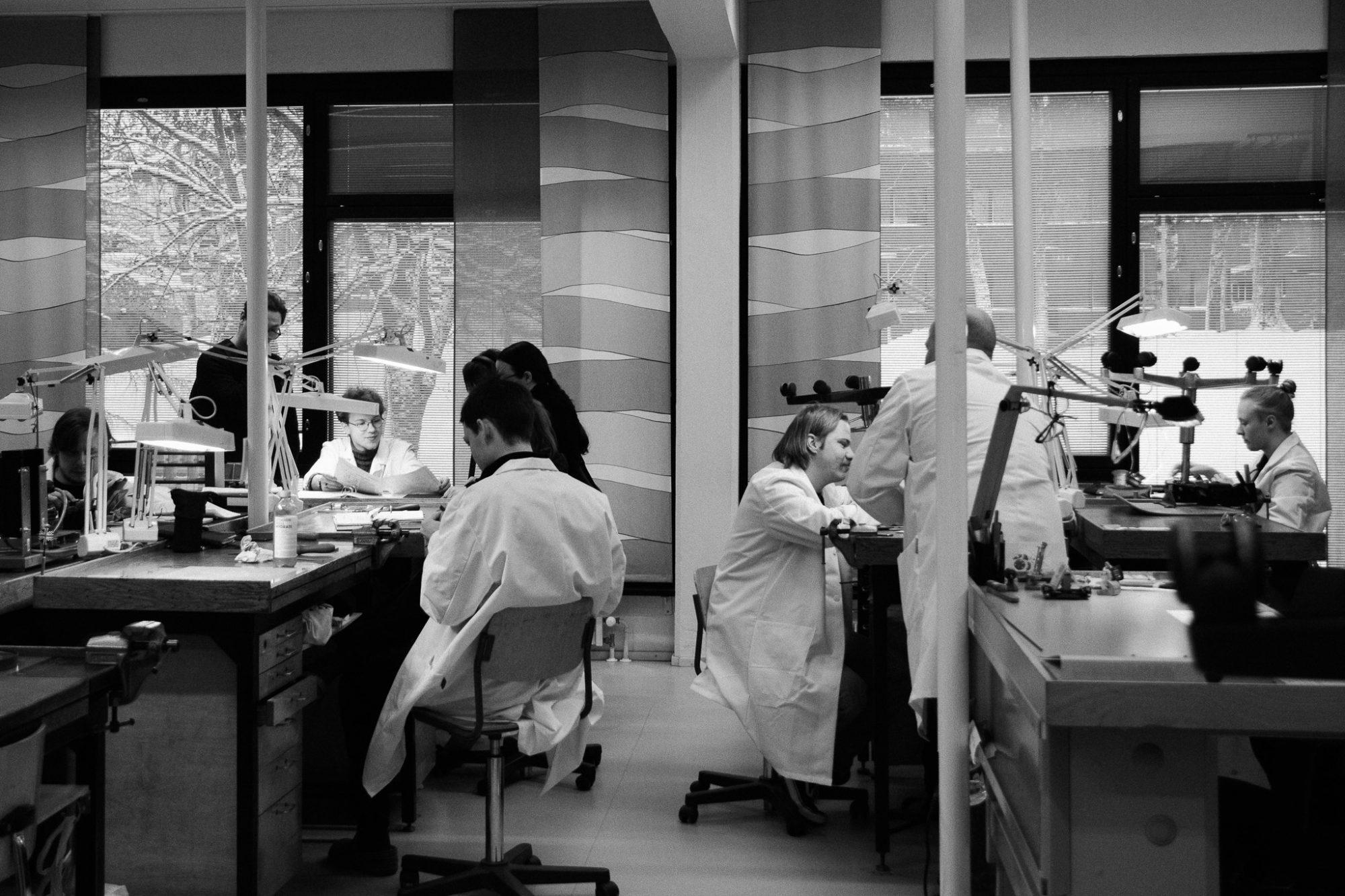
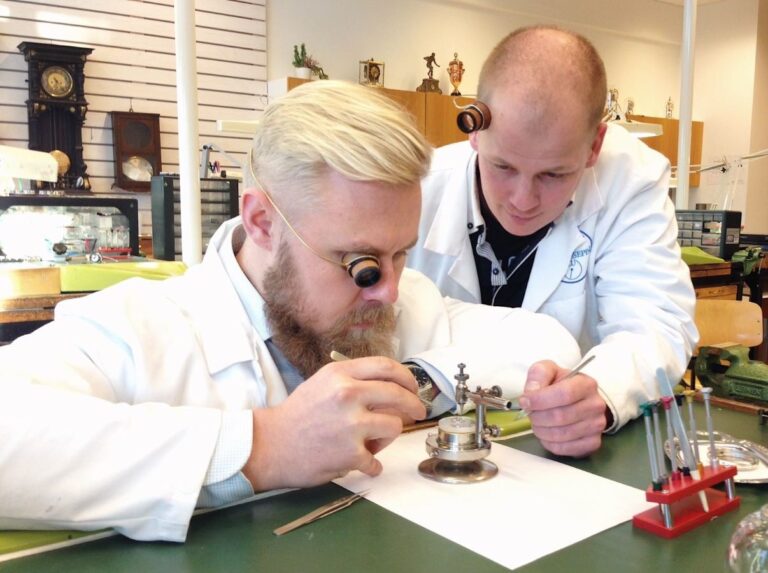
Degree Program in Watchmaking and Micromechanics
N.B. The Degree programs in watchmaking and micromechanics are taught in Finnish only. For international applicants we recommend The Independent Watchmaker course.
__
Applications for the Vocational Qualification at the Finnish School of Watchmaking in Arts and Design are accepted on an ongoing basis via the Opintopolku.fi website. We offer training in the field of watchmaking and micromechanics.
The criteria for granting state subsidies have been amended effective January 1, 2026, to guide education providers’ offerings in line with the government program’s goals for raising educational standards. For this reason, in the 2026 admissions process, we will pay special attention to the applicant’s educational needs (missing degree, unemployment). Suitability for the field and motivation are also important selection criteria.
If you already have a higher education degree and/or are employed, we recommend exploring the opportunities to study practical skills in our courses.
We select students based on an entrance exam. After the application period ends, eligible applicants will be sent an invitation to the entrance exams. You must register separately for the entrance exam. After registration, we will send you a personalized schedule for the practical skills tests and interview. If your native language is not Finnish, a YKI 3 or B1-level test result is required. The application must be accompanied by a certificate of basic education (comprehensive school (peruskoulu)/high school (lukio)) and any diplomas from vocational or higher education studies. Students currently in comprehensive school must submit either a mid-year or final report card. Admission is conditional until the final comprehensive school diploma has been submitted.
Entrance exam
All applicants who meet the required educational background and language proficiency criteria will be invited to take the entrance exams after the application period has ended. The exact format and duration of the entrance exam depend on the number of applicants. The various parts of the entrance exam may be spread over several days. The entrance exam will include group interviews and practical skills tests. A second round of interviews will be held by phone after the main selection day for the twenty applicants with the highest scores. There is no specific way to prepare for the selection tests. They are designed to assess an applicant’s suitability for the field. Students are selected based on the suitability demonstrated in the selection tests and the applicant’s educational needs.
Notification of Student Selections
Student selections are announced on Opintopolku. All applicants who have been admitted will also be notified by email and mail. If a spot becomes available due to a cancellation, the next applicant on the waiting list will be notified immediately. Selected students must confirm acceptance of their place in Opintopolku or via email.
Watchmaking Studies
A watchmaker specialises in the repair of clocks, meters, and similar precision devices that require high accuracy, as well as in the manufacture of related parts. They are skilled in creating tools and using the basic instruments of the watch industry, employing correct work methods and materials.
A watchmaker is a top professional in the industry, capable of repairing various types of watches and manufacturing them with parts precise to the hundredth of a millimeter. They often use traditional methods and tools, working by hand.
Watch maintenance and repair, along with the manufacture and finishing of watch parts, are essential components of watchmaking studies. There are many optional courses, including repairing old watches, working with precious metals, and product development. These optional courses are common to both watchmaking and micromechanics students. A watchmaker graduate is qualified to repair and sell watches in retail or wholesale settings or to operate as an independent entrepreneur. Many graduates also find employment in related fields that require precision work skills.
Micromechanic Studies
A micromechanic is an expert in precision craftsmanship, with skills rooted in mechanics and electronics. They are capable of producing prototypes and small series for company product development tasks.
During their training, micromechanics learn about various mechanical watches, which are precise and technically demanding devices. In watch maintenance and repair work, they acquire the skills necessary for handling, assembly, and lubrication of parts. They also learn the cleanliness standards of precision equipment and the techniques for testing and continuously evaluating work quality.
The micromechanic training program has been developed in collaboration with the precision industry. The three-year training includes several periods of on-the-job training at companies in the field. In the final year, micromechanics undertake an independent product development project under the guidance of a supervising teacher.
Graduates from the micromechanics program work in a wide range of fields. They have been employed by space technology companies, machine shops, innovative small industrial companies, companies in the optical sector, instrument technology and medical fields, as well as Finnish and international research institutes.
More information about the studies
Studying in the watchmaking and micromechanics programs is focused on face-to-face learning, primarily on weekdays from 8 am to 4 pm. We emphasize the systematic development of manual skills, progressing in an upward direction. Based on our decades of experience, we know this requires extensive work hours and constant guidance from professional teachers. Each student receives a personal study plan based on their previously acquired skills. It is also possible to study through an apprenticeship under the guidance of an experienced workplace instructor. Part-time study alongside work is not an option in our program.
During their studies, students need tools, books, and materials, with total costs ranging from approximately €1900 to €2300, mainly incurred in the first year. These tools and books often serve a long career after school. A computer is also necessary for completing the common parts of the degree (mainly online studies in cooperation with Omnia) and for modeling exercises. For compulsory students, Kellospäppakoulu provides the necessary equipment on loan.
The academic year at the watchmaking school starts on August 1 and ends on July 31. Local teaching begins in early August and concludes at the end of May. There is a one-week break in October, a two-week break at Christmas, and an eight-week break in February.
VIDEOS OF STUDIES
The students of the watchmaking school talk about their studies and their experiences of working in the field.
Iida Lanki
What do watchmaking studies consist of? Iida, a student in the watchmaking school, talks about her watchmaking studies and work experience in the field. Today (Spring 2024) Iida works in Kari Voutilainen's studio in Switzerland.
Rene Valta
Rene, a student in the watchmaking school, tells more about his studies and employment opportunities for watchmakers.
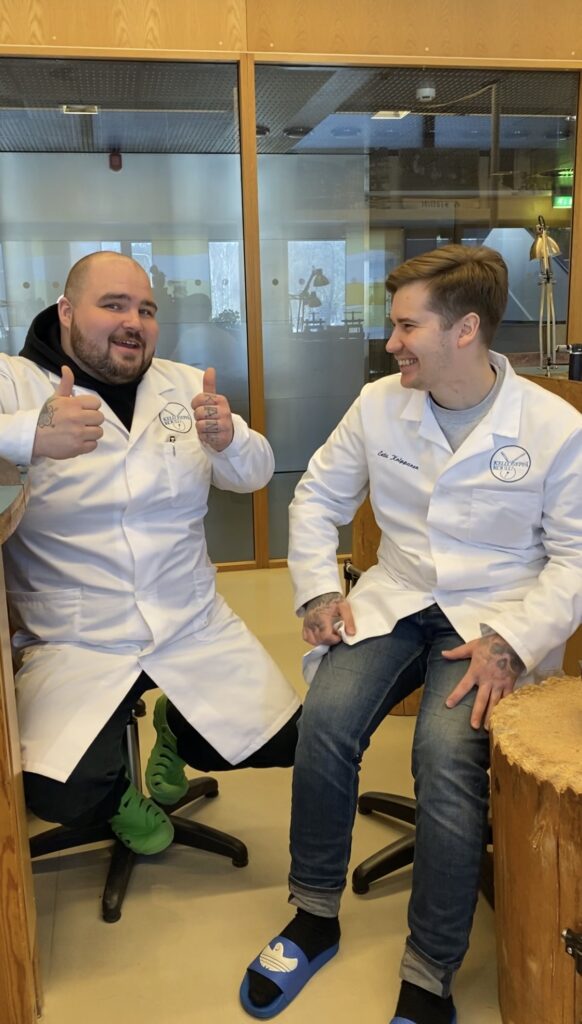
Julli Huikkonen & Eetu Kolppanen
What is the difference between a watchmaker and a micromechanic? The students tell about the studies of micromechanics and watchmakers.
WHY APPLY TO the finnish school of WATCHMAKING?
High-quality teaching
Competent and encouraging teachers.
Years of experience
Training in traditional watchmaking skills since 1944.
Working environment
A warm and close community spirit.

